As a Machine and Parts: a novella (12/2011)


Mitchell, a twenty-something Cougar Cub with Marsha, his midlife girlfriend, wakes each morning, living an ever-thinning line between human and machine. As his literal condition progresses he looses his capacity for human emotion, and potentially with it, Marsha.  As a Machine and Parts is a story of Mitchell’s struggle to discover which assembly line he belongs Read more

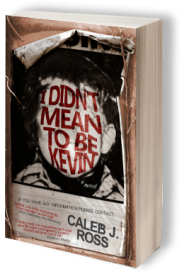
I Didn't Mean to be Kevin: a novel (1/2012)


Jackson Jacoby is a motherless twenty-two year old boy with only the support of his crazy ex-military Uncle Marve and a kindred motherless peer named Creg. Creg holds fast to the hope of one day reuniting with his mother while Jackson maintains that his own life is so much better off without all the baggage that comes along with being somebody’s Read more

Charactered Pieces: stories


With Charactered Pieces, Caleb J. Ross presents a varied world of familial discord, one where a dead fetus evokes more compassion than its mother (“Charactered Pieces”);  where two brothers offer the destruction of a family legacy as a birthday gift for their aging father (“My Family’s Rule”); where one brother’s love of Holocaust documentaries pushes his family through the aftermath of his assumed suicide (“The Read more

Stranger Will: a novel


In this novel of impending fatherhood, an idealistic teacher recruits a pliant protégé to join her group of Strangers – a devout collection of kindred minds who have dedicated their lives to cultivating a unique idea of perfection. But joining is easier than Read more

Marketing

Validating the three publishing options: Traditional, Small/Independent, DIY

Posted on by Caleb J Ross Posted in Marketing, Other Writers, Study (the world/the craft) | Leave a comment

Honestly, when in the company of commercial press authors, defending my place as independent press author can be difficult. To those who have “made it” into the commercial presses, I would assume my defense comes across not nearly as articulately and convincingly as I would hope. Afterall, the examples of small press authors immigrating into the world of commercial presses far outweighs the number of commercial authors willing to emigrate to the small press world. The commercial press gatekeeper is much more discriminating than the indies; I understanding the disbelief. I too would go commercial if given the right opportunity.

But things are getting easier. Not only are small press books showing face on historically commercial press-dominated shortlists (the recently announced 2010 National Book Critics Circle award finalists includes quite a few small press titles), but with the help of Jane Friedman the various publishing paths have been defined, and by extension, validated.

In the summary of her Writers Digest Conference 2011 talk on publishing options Friedman very clearly explains what she sees as the basic three options for publishing:

  1. Tradition
  2. Independent or niche presses
  3. Self-publishing/DIY publisher

But more, she outlines the viability of each path and goes even further to categorize according to which path that might suit them best. Her bullet-points follow:

Pros, Cons, and Requirements:

Traditional publishing:

  • It’s a commercially-driven business
  • Competitive – many people are trying to break in
  • National distribution – your work needs to merit that
  • Slower to market (usually)
  • Not the time to experiment
  • Persistence & patience
  • For non-fiction: you need a platform

Small/independent press:

  • Weaker distribution, smaller print run
  • More personal attention, dedication
  • Usually less money
  • Niche marketing – smaller, specialized market; they’re experts in the field
  • More accepting of “art” (could be nonprofit), more service-minded

DIY:

  • Entrepreneurial spirit
  • Direct connections with readership (for sales)
  • Must be comfortable with technology
  • Must enjoy connecting with people (online and off)
  • Requires energy to market and promote

ALL of the options actually require energy to market and promote.

It all boils down to you – your strengths, your work, your readers – to determine what’s best.

Hell, just read the original post. Read more

Ideas I’ve had (probably while drinking): bottle stories

Posted on by Caleb J Ross Posted in Marketing | Leave a comment

The beer bottle label is grossly misappropriated real estate. When sold as a six- or twelve-pack, the bottle label is hidden by the outside packaging. And nobody buys a single bottle of beer. So why not use the label for something more than null-advertising? We drink for the morning after stories over greasy breakfast, so why not pull those stories back by a few hours and give them when drinking?

The content of the stories could be anything from true life tales of drunken debauchery, to short fictions that somehow involve drinking, to short bios of famous authors (and their drunken exploits), to stories that incorporate the unique canvas (stories about glassblowers or, if drinking a red ale, vampires).

For those advertising traditionalists, the label facade could be left intact, reserving a hidden underside for the story. Think the way cigarette cartoons often display coupons.

Attention investors: money please!

You decide what I wear; voting for the STRANGER WILL cover

Posted on by Caleb J Ross Posted in Book News, Marketing | 19 Comments

VOTING HAS ENDED.

You get to choose the cover of my forthcoming novel! Go to the Otherworld Publications voting page and vote for your favorite Stranger Will cover. Seriously, the winner is the winner. No Florida re-counts here (dated reference, I know).

I do like one more than the others. But which one, I won’t say. The novel is set to be released on March 18th, 2010. Voting ends on November 30th. That means if I don’t get the cover I want, I have 3 1/2 months to cry about it.

Click here to vote.

Click on cover images below to see full size image.

1-Vertical Bench, white 2 – Birds on Wires, red
[Picture Deleted] 


[Picture Deleted] 


3 – Snowy Bench, shadow title 4 – Snowy Bench, floating title
[Picture Deleted] 


[Picture Deleted] 


5 – Mirror Trees, sideways title 6 – Mirror Trees, wraparound title
[Picture Deleted] [Picture Deleted]

Search Engine Optimization (SEO) for Authors

Posted on by Caleb J Ross Posted in Marketing, SEO for Authors | 3 Comments

During a recent discussion on NPR, Heather Fain, marketing director for the publisher Little, Brown and Co. said that “the greatest marketing tool we have in publishing — and probably will never change — is word of mouth.” This means not only literal friend-to-friend and bookseller-to-buyer hand selling, but also online forums, reviews, blog comments, and social network discussion. For the most part, authors have little control over this. One aspect authors can control: the old fashioned website.

Optimizing a website so that it can be more easily found by readers is to most authors, I would assume, a foreign concept. Not that I am discrediting authors; I simply hope that most of you aren’t as nerdy as I am. Having a platform (re: a stable of willing buyers) is becoming more and more important to publishers. Optimizing your web presence is an important way to grow that platform.

Many of the SEO (Search Engine Optimization) best practices for commercial sites are relevant when working with a personal site. Keyword-rich content, meta development, inlinks, all of these things are important. However, there are some major differences to consider. I’ll be focusing on those differences.

First, determine the purpose of your website. Is it to covert sales? Is it rack up a long list of newsletter subscribers? Is it to provide general awareness of yourself and your books? Most of you are likely part of the third item—most book sales will happen off-site, at either an online book store or through a brick-and-mortar store; and newsletters, though highly converting [1], are generally geared more toward e-commerce consumers and repeat consumers. There is a place for all three of these items in a single website, of course, but I’m going for focus in this already lengthy post.

Monitoring Traffic

You need a way to analyze your website traffic. I recommend Google Analytics because it is free, extremely robust (intimidating so), and super easy to incorporate. If you can’t measure your site’s performance, you’ll never know if you efforts are truly working. Some free blog sites don’t allow Javascript (which Google Analytics uses), but in those cases the blogging platform usually has a rudimentary traffic measuring application already built in.

Keywords

Think of keywords as the terms used to find a website. For example, someone may type Hoist That Rag meaning and end up seeing my page in the Google search results. And in fact, they did:

Hoist that Rag meaning

The 8th, 9th, and 10th top referring keywords for a given time-frame

Using Google Analytics, I can see what terms people searched to find my site. I recommend expanding your keyword set using these terms as a guide. For example, using the term Hoist That Rag meaning, I could imagine that people coming to my site might be interested in Tom Waits, Tom Waits Lyrics, and perhaps more generally, downtrodden, crooner, barfly personas. Additionally, keywords that searchers may not have used, but ones you feel are relevant to your site, are worth considering. For example, nobody came to my site using the term “grotesque noir fiction,” but I may want them to. I’ll add that to my list.

So, what to do with this keyword knowledge…

Content

By “content” I am going to be focusing on blogs. Individual page content, such as your bio, about, and work pages should be filled with keyword rich content, but blogs offer a more consistent stream of new content, which search engines (and readers) love.

Write blog posts that blend what you want to say with what you know people have already searched for. Keeping the examples above, I could write posts about barflies, Tom Waits, and perhaps how many of his lyrics feel like grotesque noir (“Eyeball Kid” comes to mind). The basic idea is to give search engines as many opportunities to validate your site in the eyes of readers.

Search engines put a strong focus on in-bound links (re: links from other sites to yours). When content is created specifically to attract links, this is called link bait. So how can you use your site’s past performance to anticipate link bait opportunities? I’ll use an example from my site to illustrate.

On July 6th, I noticed a spike in site traffic. Upon digging into my analytics, I found that a recent post, “Great Unexpected Literary References,” which highlights literary references in cartoons, managed to be linked to by a couple moderately popular literary blogs.

Traffic Spike

A July 5th spike in traffic. What is this about?

To capitalize on potential continued interest in this type of content, I then created more content with similar ideas. And in fact I started an Unexpected Literary References category for this very purpose. It continues to be a fairly popular category (in terms of my site’s overall traffic).

Content is great for bringing readers to you, but what about getting your content in other places?

This is part of what is called off-site optimization…

Community participation

Getting content and in-links is important to search engines, but don’t forget that you are blogging for human readers. Comment on other blogs, join forums, follow authors on Twitter, friend authors on Facebook, but above all, be active. Involve yourself in the online literary community. This is good practice, even if you don’t have a site to promote.

Basically, by proving your love to other humans, as a byproduct, you will be proving your worth to search engines. Each LEGITIMATE link you put out there is another rung in your search engine ranking ladder (notice the word LEGITIMATE; spamming is bad, search engines are smart about penalizing you for spammy links, and humans are smart about blacklisting shits who throw irrelevant links all over the web).

But you only have so many hours in the day, you say…

Be your own Press Release distributor

Use RSS to import your blog feeds into your various social networking and profile pages. Goodreads, Amazon, and Facebook, for example, allow authors to have their blog posts automatically posted to profiles. This means that you hit “post” once at your own blog, and your content feeds to those various other networks.

Be sure to cross-link all of your profile pages and your website. If possible, list your Twitter, Goodreads, Facebook, YouTube, Fictionaut, and all the other social pages you maintain on all of those various networks. Sometimes, you are only allowed one site link. In this case, I would recommend listing your website. A close second would be your Facebook profile.

Profile links in my homepage sidebar

Profile links in my Facebook sidebar

Measuring conversions

Since most author pages aren’t focused on product conversions (purchases usually take place off-site, at an Amazon.com or independent bookseller like Kansas City’s Rainy Day Books) it doesn’t make sense to focus on actual product sales as a measure of performance. If looking to measure conversions, a newsletter sign up or comment submission may be more appropriate. Think of yourself as being in the business of establishing a relationship, not in the business of bookselling. Google Analytics has a built in method of tracking conversions.


(Note: for those of you already familiar with SEO, you will notice that I didn’t include anything about meta content, title tags, <h> tags, and other behind-the-scenes tactics. I avoided these simply to keep this article focused. I may touch on them in the future)

[1] ExactTarget is an email marketing company, so be weary of fully embracing these numbers.

White covers and isolated imagery: Why the trend?

Posted on by Caleb J Ross Posted in Marketing, Study (the world/the craft) | 1 Comment

I have noticed that over the past decade readers have been subjected to a trend in non-fiction book cover design. I am referring to the use of a white background to frame a single, striking element. For example:


I understand the appeal from a marketing perspective. As online book buying grows in popularity, the book spine is becoming less important to shoppers. Instead, the idea with white-framed covers is to create as much visual distance and isolation with a book so as to set it apart from its surrounding mosaic. An added benefit for non-fiction books in particular is the sense of authority that comes with a single image. This says, “I am an expert on this topic. I am not going to stray into superfluous details. Prepare to learn.”

I like the look, but I dislike the trend. I am a grump, though, and dislike most trends. I refuse to tell my wife that I don’t mind listening to her Ingrid Michaelson music simply because it’s on the radio sometimes. I even hate hipsters because they are too popular. How’s that for irony?

I collected many, many such covers (and it didn’t take me long to do). Flip through the gallery below to see. Now, as an exercise in the inevitable futility of following trends, try to see if any of the white-framed books stands out when packed together with so many similarly designed books. Answer: none stand out. This book, if it were thrown into the mix, would certainly stand out. Here’s hoping busy book covers don’t become a trend.

Resurrecting the Author Career, Returning to Whisky and Words

Posted on by Caleb J Ross Posted in Marketing, SEO for Authors, Study (the world/the craft) | 2 Comments

Disclaimer: I am far from a career author. I’ve made enough money to buy a few fifths of whisky and some diapers for my baby, so needless to say I’ve got a long way to go. The following plan reflects this outsider (re: possibly ignorant) perspective.

The idealized author spends his time alone, churning out typewritten manuscripts to meet constant deadlines. He drinks. Probably smokes. He’s respected. He vacations in tropical seclusion, but still, even with the changed view, he writes. He has no day job. He is an author. Writing puts his kids through college.

There is a reason this image contains a typewriter. Much like the machine itself, the idealized author is all but extinct. I think a lot of writers would like to go back to this model. Is it possible to not just retain the author career, but to make it thrive?

Given the following set of assumptions, I believe it would be possible to bring back the author career:

  1. Content will continue to outweigh consumption
  2. The marketplace is spoilt by free content, and much of that content will continue to be free
  3. eBooks/eReaders will be a primary content medium within the next decade
  4. The cost to produce and distribute market-quality products will continue to fall

More authors are producing more content than ever, so it’s fair to say the larger onus is on the publishers to bring back the career. The problem is that publishers have no incentive right now to court authors in the way they once did. Publishers have the above items #1 and #2 going for them. A culture of expected free content coupled with an overflow of content, means authors have been trained to work for cheap or free.

But, authors have items #3 and #4 above as important pieces of leverage. If publishers don’t adapt to the changing market, and work with authors to do so, then the publishers will die. Because authors have the ability to create and distribute their own work, and because they have been trained to work for nothing, authors have little to lose by abandoning the publisher. Without authors, publishers die. Without publishers, authors continue.

What can be done?

  1. Consolidate the agent and publisher roles. Basically, this combined entity should act as a time and beaurocracy manager for authors. Today, authors have the ability to publish and distribute their own content without the help of agents and publishers. If this Pub/Agent composite can give authors time to write, then they will ultimately be given the sort of consistent product that the marketplace loves. Marketing thrives on trends. Giving authors time is the way to nurture trends.
  2. Increase author royalties. As media becomes electronic, the savings on overhead and distribution must be passed on. Court your talent, publishers. I’ve read the arguments against electronic media being cost-savers for publishers, and I just don’t believe them.
  3. Embrace the eBook paradigm shift. As a reader, I haven’t yet fallen in love with eBooks. As a writer, I am very excited by the possibilities. Instead of fighting to keep print alive, fight to make eBooks thrive. eBooks have the potential to increase the pool of readers, much as the iPod did for music enthusiasts.
  4. Brand yourselves as independent records labels do. Make fans out of your press, not just out of your authors. I won’t go into much depth here about this, but we do have an episode forthcoming at the Welcome to The Velvet podcast on this topic.

What can writers do?

  1. Provide consistent and brandable content. As Dan Holloway says in the comments at Jane Smith’s How Publishing Really Works blog, “If you are writing for the art, by all means try your hand at getting an agent, but don’t be upset if you don’t get one – and if the feedback is that you should be more commercial in order to get one, then make the decision – do you want to write for the pay packet, or do you REALLY want to do it for the art? And if it’s the latter, don’t expect to be picked up, or blame the publishers when you aren’t.”
  2. Prove that you can provide that content. As Jane Smith says in a response to the above comment, “I think that a big reason that most writers make such a paltry amount is that there are lots of people out there who call themselves writers but who only really dabble with writing: they sell an article every now and then, take several years to write just one book; sure, they’re writers–but not full-time, serious writers.”. A career author must write as though it is a career.

I want to sit alone and write fiction for a living. Help me do that. Make me believe.

Read more

Have you heard about the new fake James Patterson book?*

Posted on by Caleb J Ross Posted in Book News, Marketing | Leave a comment

James Patterson new novel*neither James Patterson nor Stephenie Meyer wrote this book**

**Thank fucking God***

***though I wouldn’t mind their sales. Get to it, asterisks readers.