
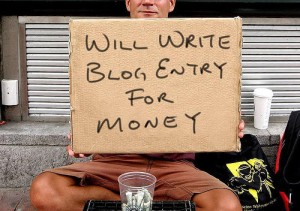
 Disclaimer: I am far from a career author. I’ve made enough money to buy a few fifths of whisky and some diapers for my baby, so needless to say I’ve got a long way to go. The following plan reflects this outsider (re: possibly ignorant) perspective.
The idealized author spends his time alone, churning out typewritten manuscripts to meet constant deadlines. He drinks. Probably smokes. He’s respected. He vacations in tropical seclusion, but still, even with the changed view, he writes. He has no day job. He is an author. Writing puts his kids through college.
There is a reason this image contains a typewriter. Much like the machine itself, the idealized author is all but extinct. I think a lot of writers would like to go back to this model. Is it possible to not just retain the author career, but to make it thrive?
Given the following set of assumptions, I believe it would be possible to bring back the author career:
- Content will continue to outweigh consumption
- The marketplace is spoilt by free content, and much of that content will continue to be free
- eBooks/eReaders will be a primary content medium within the next decade
- The cost to produce and distribute market-quality products will continue to fall
More authors are producing more content than ever, so it’s fair to say the larger onus is on the publishers to bring back the career. The problem is that publishers have no incentive right now to court authors in the way they once did. Publishers have the above items #1 and #2 going for them. A culture of expected free content coupled with an overflow of content, means authors have been trained to work for cheap or free.
But, authors have items #3 and #4 above as important pieces of leverage. If publishers don’t adapt to the changing market, and work with authors to do so, then the publishers will die. Because authors have the ability to create and distribute their own work, and because they have been trained to work for nothing, authors have little to lose by abandoning the publisher. Without authors, publishers die. Without publishers, authors continue.
What can be done?
- Consolidate the agent and publisher roles. Basically, this combined entity should act as a time and beaurocracy manager for authors. Today, authors have the ability to publish and distribute their own content without the help of agents and publishers. If this Pub/Agent composite can give authors time to write, then they will ultimately be given the sort of consistent product that the marketplace loves. Marketing thrives on trends. Giving authors time is the way to nurture trends.
- Increase author royalties. As media becomes electronic, the savings on overhead and distribution must be passed on. Court your talent, publishers. I’ve read the arguments against electronic media being cost-savers for publishers, and I just don’t believe them.
- Embrace the eBook paradigm shift. As a reader, I haven’t yet fallen in love with eBooks. As a writer, I am very excited by the possibilities. Instead of fighting to keep print alive, fight to make eBooks thrive. eBooks have the potential to increase the pool of readers, much as the iPod did for music enthusiasts.
- Brand yourselves as independent records labels do. Make fans out of your press, not just out of your authors. I won’t go into much depth here about this, but we do have an episode forthcoming at the Welcome to The Velvet podcast on this topic.
What can writers do?
- Provide consistent and brandable content. As Dan Holloway says in the comments at Jane Smith’s How Publishing Really Works blog, “If you are writing for the art, by all means try your hand at getting an agent, but don’t be upset if you don’t get one – and if the feedback is that you should be more commercial in order to get one, then make the decision – do you want to write for the pay packet, or do you REALLY want to do it for the art? And if it’s the latter, don’t expect to be picked up, or blame the publishers when you aren’t.”
- Prove that you can provide that content. As Jane Smith says in a response to the above comment, “I think that a big reason that most writers make such a paltry amount is that there are lots of people out there who call themselves writers but who only really dabble with writing: they sell an article every now and then, take several years to write just one book; sure, they’re writers–but not full-time, serious writers.”. A career author must write as though it is a career.
I want to sit alone and write fiction for a living. Help me do that. Make me believe.